
B.Sc. in Anesthesia Sciences
Program Profile
The Anesthesia Sciences (ASD) Department was established within the College of Health Sciences in August 2012. Its first and main academic programme is the Bachelor of Science in Anesthesia Sciences. The programme welcomed its first cohort of students in October 2012.
The programme is designed and regularly reviewed to meet the current and future needs of the Kurdistan Region and Iraq for qualified Anesthesia technologists. The curriculum adheres to ABET requirements and provides a balanced foundation across Anesthesia Sciences fields. Laboratory sessions further strengthen students’ design abilities, teamwork, and hands-on technical skills.
The graduation project is a major design component of the programme, promoting creative problem-solving and effective teamwork. Internships, in turn, offer students valuable opportunities to apply their knowledge in real world settings. Internships also strengthen health connections and help academic staff stay engaged with community needs, many of which can be addressed through students’ graduation projects.
Additionally, the programme help students to tailor their education according to their interests and evolving market demands.
Occupational profiles of graduates
Graduates of Anesthesia Technology are allied-health professionals trained to assist anesthesiologists and provide safe patient care before, during, and after surgical or diagnostic procedures. Their occupational roles span clinical, technical, educational, and administrative domains.
Main Roles include:
- Prepare anesthesia machines, drugs, and airway equipment; assist in giving anesthesia; monitor patients; maintain sterility and safety.
- Support anesthesia and surgical teams during operations; handle ventilators and monitoring devices.
- Set up ventilators, monitoring systems, and assist in patient transport.
- Help with airway management and CPR in emergency departments (with extra training).
- Maintain and troubleshoot anesthesia machines; perform quality checks.
- Teach students in labs or classrooms (with experience).
- Manage supplies, equipment inventory, and OR workflow.
Qualification awarded
Bachelor of Science degree in Anesthesia Sciences
Length of programme
4 Years
Number of credits
240 ECTS credits
Mode of Study
Full time on campus with internships in hospitals and medical centers
Read more about the programme
Get detailed information about the programme requirements, courses, credits, and educational objectives as a PDF file.
Program Educational Objectives (PEOs)
The Program Educational Objectives (POEs) of the Anesthesia Sciences department (AnSc) are to prepare graduates who will:
- be competent, compassionate, and ethical healthcare professionals who can provide high-quality perianesthetic care as part of a healthcare team.
- have a core knowledge of established and evolving biomedical and clinical sciences related to anesthesia. Students must be able to apply this knowledge in clinical situations using an analytical approach.
- exhibit strong leadership, communication and teamwork skills, enabling them to work effectively within multidisciplinary teams.
- engage in lifelong learning through advanced education, professional development, and certifications or other learning opportunities to adapt to evolving technologies, drive innovation, and contribute to the development of new technologies.
Program Learning Outcomes
After successfully completing this programme, students should be able to:
- apply core knowledge: Understand and apply foundational knowledge in anesthesia, physiology, and pharmacology to patient care.
- combine knowledge of anesthesia procedures, patient care, and perioperative practices to manage patient care.
- demonstrate the ability to safely and effectively administer anesthesia and manage nerve blocks.
- practice effective communication skills with patients, families, and the inter-professional team.
- practice ethical and moral behavior, maintain patient confidentiality, and apply ethical principles in all dealings.
- contribute to self-performance evaluation and engage in continuous improvement.
- demonstrate the ability to adapt to new information and techniques in the field.
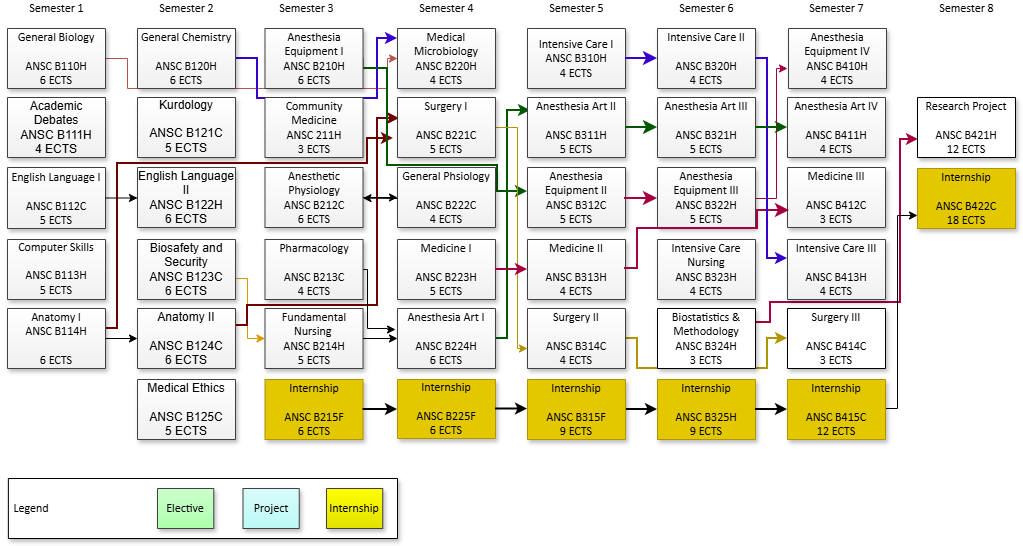
Programme structure diagram with credits
Yearly Timeline
Sept. 1, 2026
⚠️ First year students start around mid-October
⚠️ First year students start exams around 20 of January
July 1, 2027
Check out the full academic calendar on UoD's webstie.
Programme Coordinator

Medical Laboratory Sciences
College of Health Sciences
University of Duhok
Apply to the Programme
Public undergraduate admissions in the KRG region are managed centrally by the Ministry of Higher Education through the online ZankoLine portal (regayzanko.com). After Grade 12 Baccalaureate results are released, high schools provide students with unique login credentials to rank their preferred universities and B.Sc. majors during a 10–14 day registration window. Final placement is automatically determined by the student's Grade 12 average, subject choices, and department capacity.